
Interview with Roddie Watt, who worked on The Victor for a couple of years, (keeping his head down), before moving onto being a scriptwriter for The Beano, Topper and other D.C. comics.
Please scroll on down this page for the interviews with James Halley editor of The Victor, Keith Shone, artist and Bill Graham, who was an editorial assistant for The Hornet.
Interview conducted via e-mail, January 2011. Roddie didn't have much to say about his time working on the Victor as he was only a junior in the office. The interview then moved on to discussing his approach to the writing of comic scripts, in particular for The Beano.
RW refers to Roddie Watt.
Q. Could you please provide a short working biography?
RW: I started working for DCT on The Beano as a scriptwriter aged 17 in 1984. A year later I moved on to Suzy, a magazine for pre-teen girls, for a couple of years. I then started on Victor which was for about 2 years. Next it was back to scriptwriting on The Topper for a year. I returned to The Beano scripting for 7 years. A shift away from editorial took me to the licensing & merchandising department in 1997. I continue to work within that department, now re-branded Consumer Products, as Licensing Business & Marketing co-ordinator.
Q. What were your main duties as a Victor Editorial Assistant?
RW: I would handle my allocated stories to sub and prepare for process - title, captions and balloon placement. You had to select a dynamic/action frame from one of the pages which would be blown up and re-fitted on to the page with assistance from the art department. Also, a good picture from the following week's episode would be turned into a 'bump' print and placed in the 'next week' box with an apt tailpiece. If it was a reprint, the negatives were made into postive prints and checked for typos, any subbing amends required (e.g. outdated culture references etc.). There was also the letters, jokes and various feature pages.
Q. Did you write any of the stories in The Victor?
RW: No. The stories I worked on were already written including reprints of course.
Q. Why didn't the artists and writers names never appear on the stories?
RW: It was DCT policy at the time.
Q. What made you want to work in the comics field?
RW: I didn't! I originally applied to work as a junior on Jackie, Blue Jeans & Patches. After a few interviews the teenage magazine people suggested I may be more suited to Boys Papers. So I continued through the interview process with management, editors and chief subs of the comics. A few months later I was offered a job as a scriptwriter on The Beano
Q. What comics did you read as a child and do you read them as an adult?
RW: I was very lucky - my dad was a mechanic on the printing presses and one of the perks at the time was having access to all the loose copies lying around. So Dad would bring home just about every DC Thomson publication for the family!
Q. Can you explain how a script should be written?
RW: If there was ever a question that could be answered in a million different ways, this is it! I think as long as your journey ends with a good twist/punch line/pay-off illustration/clever word use and 99.9% of the time it is, most importantly, amusing to the reader then you are on the right lines. How you get there is the art of scripting and coming up with a germ of an idea be it at the beginning, middle or end of the story is how you confront that blank sheet staring back at you.
Q. When you were writing scripts was it a solitary affair or more of a team effort?RW: You were on your own most of the time. On occasion there would be a ‘round table’ where everyone would throw in a few ideas, but even then it would still stem from your basic idea if it was one of your regular characters/stories.
Q. How many scripts would you be expected to produce a week?RW: A minimum of one script per character but there was no rule. For example you could have a few story ideas for a particular character in the space of an hour. It just depended on your creative streak there and then. Best not stop when you are on good run of inspiration!
Q. What would be a typical week for you as a scriptwriter?
RW: Get the stories prepared for press for the end of the week. Work with the art department in getting the pages ready for the process department by getting story title pictures illustrated, captions, balloons, top lines & sound effects placed. Open the readers’ letters, jokes & drawings and prepare for the letters page, organise internal ‘house’ ads for all DCT publications for any free gifts/promotions/competitions. There was always something else on the go in tandem with the weekly comic such as stories and features required for the annuals and a calendar.
Q. Could you introduce your own ideas based on your own experiences or hobbies, interests into a story as long as it fell within the editorial guidelines?RW: All the time. Most stories are based on something you heard, read, saw or even dreamt. Your job was to give it a twist as mentioned earlier regarding how a script should be written. Sometimes you don’t even know where an idea springs from – just be glad it is there and get it down into some kind of form for the story you are writing or keep it on the backburner for another time.
Q. Did you create any new characters?RW: There was always the potential for background characters you created and incorporated into a story. If they had enough comic potential could re-appear now and again. However, we did have a laugh during downtime creating characters that would never see the light of day for all sorts of reasons...!
Q. Which strip or character that you wrote scripts for are you most proud of?RW: For The Beano I really enjoyed writing Baby-face Finlayson The Cutest Bandit In Town because he is such a bizarre character who speaks in effected dialogue as like some faux classically trained actor. Considering himself a master criminal of the highest order he would indulge in petty crimes such as pinching sticks of rock from helpless babies, utilising his motorised pram as a getaway vehicle. More often than not he was caught by his own hopeless planning ending up behind bars. I loved that! There was one year when each of us agreed to produce all the stories for a particular issue of The Beano with a theme running throughout the comic. I wrote the Christmas issue which felt like a nice achievement.
Q. Were you assigned to the same character or strip every week or did you provide scripts as required?RW: You did have your own stable of characters but you were free to write anything. We would sometimes swap characters with each other every few years to freshen things up. It was good to inherit a new story and put your mark on it.
Q. What were the editorial guidelines you had to work to when you were a scriptwriter for the Beano?RW: Unwritten guidelines that is! You had to have a built-in feel for what is right and what is wrong. The bottom line was to write something appropriate, in-character and most importantly entertaining for the core reader which was about 8-10 years old.
General comment - I recently read an article where a writer had visited the Beano offices in Dundee and found people testing out new free gifts, firing objects from catapults, flying model planes and so on. (Sounds a bit like our office. The younger element enjoy twanging rubber bands at each other and we’ve learned that paper planes made by our Russian colleague, fly longer and further than British designs).
RW: That must be why there are so many scripwriters missing an eye!
Thank you for answering my questions. My thanks to Calum Laird for the introduction to Roddie Watt.
Interview conducted via e-mail during April 2008. BG refers to Bill Graham.
Q. Could you provide a short working biography please?
BG: I started work as a sub editor on The Hornet when it was launched in 1963. Then came a three-year break between 1969 and 1972 when I was a football reporter. I came back and joined the staff of The Wizard (not the text story paper but the picture strip version). I was chief sub editor of Warlord when it was launched in 1974, becoming editor a couple of years later. I then edited The Crunch, Buddy, Spike and Champ.
In 1986 I was appointed editor of the new The Football Story Monthlies. Soon after that I became editor of a group of monthlies, which included Starblazer and Star Romance. In the late 1980's I also started editing the Pony Stories, and in 1990 I was asked to produce the Wendy stories for the comic of the same name.
Q. I've been hearing a lot about D.C. Thomson's military reference library. Is it still in existence today for those artists who contribute to Commando?
BG: There was no library as such. Over the years the individual offices accumulated reference books. I believe that Commando inherited all the military reference books from the boys' papers as they closed down.
Q. How was the library used in The Hornet days? For example, if an artist was drawing a WW2 RAF strip about a squadron of Spitfires, would drawings of Spitfires (uniforms and so on), be sent to the artist with the script for reference purposes?
BG: Some artists kept their own references. For others, we would photocopy the relevant refs and send them out with the scripts.
Q. I also believe that a check was made of the artwork once it arrived back in the office for accuracy purposes?
BG: All the artwork was checked when it came in from the artists.
Q. Does the library cover just military uniforms and equipment or does it also include civil information, such as police uniforms, railway trains, vehicles, style of clothing, architecture and so on?
BG: As I said, this military reference library didn't exist. On Warlord, for example we had reference books which specialised in tanks, planes, uniforms, warships etc. We also had partworks which would give general refs, such as scenes from The Battle Of Britain.
Q. What were your duties as an editorial assistant for a typical week?
BG: I would handle a couple of stories. That meant subbing the scripts before sending them out to artists. When the artwork came in, I would check it for errors. In those days, most artists submitted pencils. Any errors would be corrected at that stage. Then the pencils would be returned to the artists to be inked. I would also write the toplines and tailpieces for the stories I handled. I would also script stories. I think at some stage I also was in charge of the letters page.
Q. How did the process of creating new strips (whether they were based on text stories that had been printed previously or new), occur? For example, did you have brain storming sessions, where people came up with stories and then they were expanded as necessary?
BG: Some were picture strip version of stories which had previously been published as text stories. Others were from new ideas submitted by the staff. Every six months we would be asked for ideas. These were passed on to the managing editor of the boys' papers, Bill Blain. In conjunction with the [Hornet] editor, Alex McIntosh, he would choose the ones he ones he liked best. These were then given to freelance writers.
Q. Did you write any of the scripts adapting previously published text stories or writing completely new stories? Which was your favourite story? Do you remember anything about The Hover Rovers strip?
BG: I didn't write any new stories but I scripted some of the old stories from the files of The Rover and The Wizard. I don't recall The Hover Rovers script. I don't remember having any particular favourites, though I liked the football stories.
Q. Did you or someone else have to keep a record of who was drawing or writing which script and how long they would be scheduled to do it? In what form was this record kept? In a diary for example? (At times it must have been difficult to obtain the services of say Peter Sutherland to draw The Big Palooka, when he must have been very busy drawing the Alf Tupper stories).
BG: Every office kept a story chart.On it would be written the name of the story, the writer and the artist. The number of episodes would be recorded and, as each episode came in from the artist, that would be marked off on the chart. I think the editors would agree between themselves who would get which artist at any given time.
Q. Did you do any of the lettering for any of the strips? If so, how was this done? The lettering within the balloons is all standard and looks as though it was typed.
BG: All the type was produced on electric typewriters.
Q. Did the Hornet Editorial staff try to make The Hornet a different comic from The Victor? (To my untrained eyes, they both seem to publish the same type and style of stories). For example, I thought The Blazing Ace of Space was a very bold strip, not much in the way of laughs and possibly for its day hard hitting with Squadron Leader Starr's approach to killing pilots in combat, wherever possible.
BG: I don't think so. I think that Hornet followed the pattern set by Victor.
Thank you for taking the time to answer my questions.
**************************************************************************************************************************************
An interview with Keith Shone of Braddock fame as well as other Victor and Hornet strips.
Keith Shone's working biography.
Keith Shone was born near Mold, Wales in 1931. His art education was at Chester School of Art where he studied illustration for five years. On leaving college he started work as a professional illustrator, working almost exclusively for D.C. Thomson on boys adventure comics such as Rover, Wizard, Hotspur, Swift, The Hornet and The Victor.
In 1967 he moved to Moelfre in Anglesey and continued to be a freelance artist until 1995 when he retired from commercial work. He began painting in pastels soon afterwards. During this time he was commissioned to paint twelve large marine paintings. These are now exhibited in their own gallery at Cemaes Bay, Anglesey. The gallery is open to the public.
In common with many other artists he is attracted to the landscape of North Wales by its rugged mountains and sweeping shoreline. This is intensified by his walking and climbing in the area. His first response to the landscape is through drawing, which is central to everything that he does. This is inherited from his past as a graphic artist. In an effort to represent what he feels at the time of sketching, his paintings fully represent the subject, but with colour playing a major role, sometimes this appears unreal and bearing no relationship to time and place.
© Keith Shone, 2008.
Interview conducted during February/March 2008 via letters. KS refers to Keith Shone.
Q. Did you enjoy drawing the Braddock strips?
KS: I enjoyed drawing Braddock as he was the character I drew more than any other. I liked his anti- authoritarianism and his heroism; he remained anti-officer and never rose any higher than Sergeant. I viewed him with affection and he became an old friend.
Q. You drew a lot of flying stories was this because you enjoyed the technical side of drawing planes? (I would also say that the planes all look to be accurately drawn technically).
KS: The technical aspects of the planes and so on, had to be carefully researched and D.C. Thomson had an extensive library to ensure that we were technically correct. Children were often very knowledgeable and quick to write in if you had made a blunder in the script or the drawings.
Q. How did you work, what size and type of paper did you use and what drawing materials did you use?
KS: We worked on Bristol board using black waterproof ink to a scale of twice up (that is, 6x6 became 12x12).
Q. How many pages did you draw a week? Judging from the number of Braddock and other strips you drew, a lot!
KS: We drew an average of three pages a week.

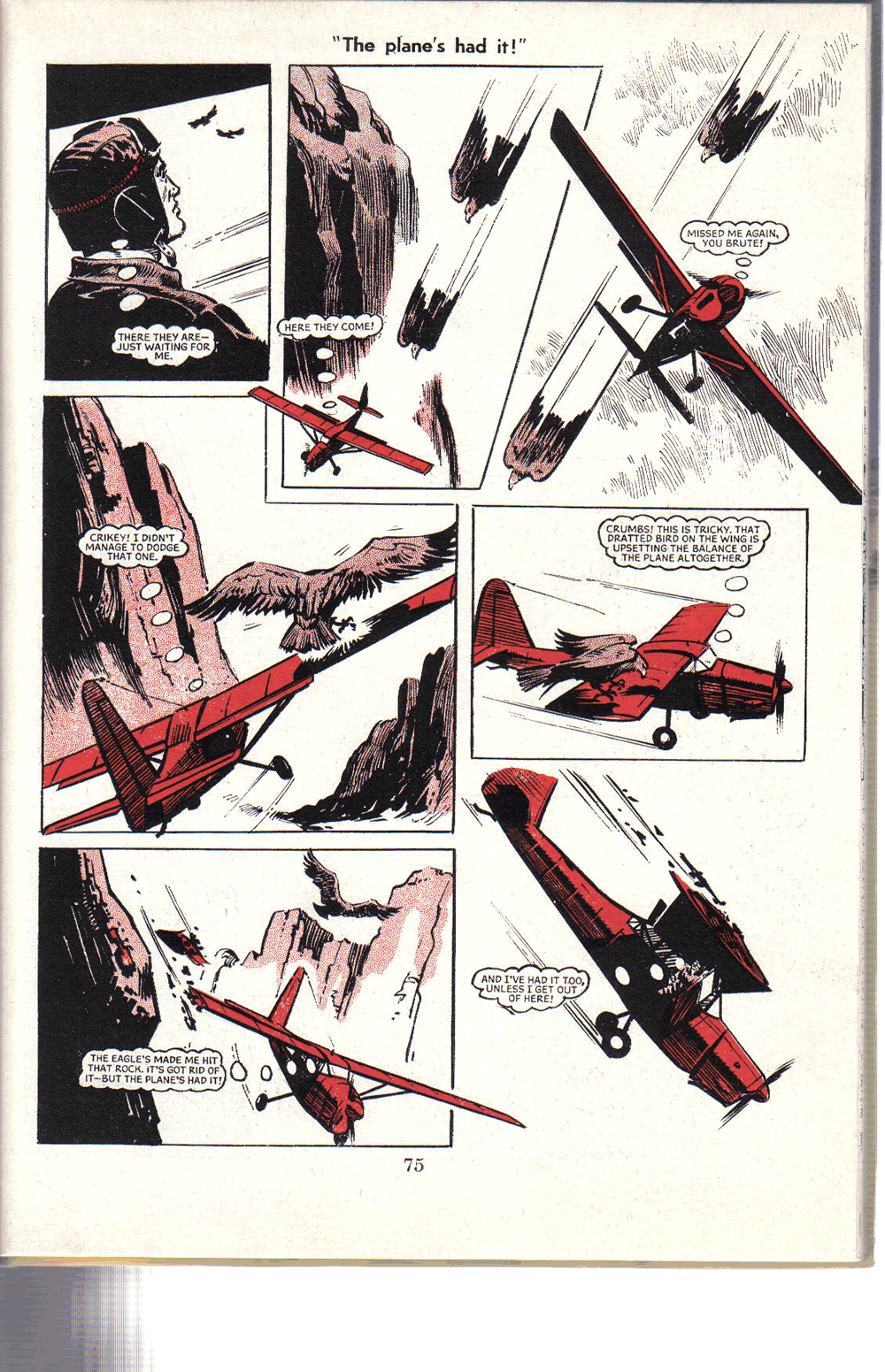
Above - part of a page from a Braddock and Bourne story from the 1969 Victor annual, drawn by Keith Shone.
Q. Did you try to put that ‘little bit extra’ into the strips that you drew? By that I mean giving the characters faces suitable expressions, detailed backgrounds and so on?
KS: We had strict deadlines to meet but always tried to go the extra mile and make the characters 'live' and of course this included the backgrounds.
Q. Where did you learn to draw, which artists inspired you?
KS: I have always been able to draw, seeing life as a series of 'pictures' and cannot honestly say that I drew inspiration from any particular artist.
Q. Did you enjoy working with any particular writers and if so why? Can you remember any of the writers you worked with?
KS: We never knew the authors of the scripts, each picture was described and we had the dialogue ballons for each character to work from.
Q. What other artwork have you done outside of the comics art field?
KS: I am now in the field of fine art and am well known in the art world. I am currently working on a painting of the famous wreck of the Royal Charter.
Q. Did you experiment with your artwork in any of the strips?
KS: I would not call it experimenting, but I did produce Billy the Kid for Fleetway Publications.
Q. Did you script any of the strips that you drew at all?
KS: The artists were never involved in producing the scripts.
Keith's fine artwork has been exhibited at the following places over the years - Canolfan Beaumaris, Llandudno Library, Colwyn Bay Library, Theatr Clwyd. Mold (annually), Electric Mountain Llanberis, Oriel Ynys Mon (solo), Tegfryn Gallery Menai Bridge, Penrhyn Castle Bangor, Plas Glyn y Wedd, Albany Gallery Cardiff.
To view some of Keith's fine artwork please click on the following link.
My thanks to Keith Shone for his time and patience in answering my questions.
© Adrian Banfield, 2008.
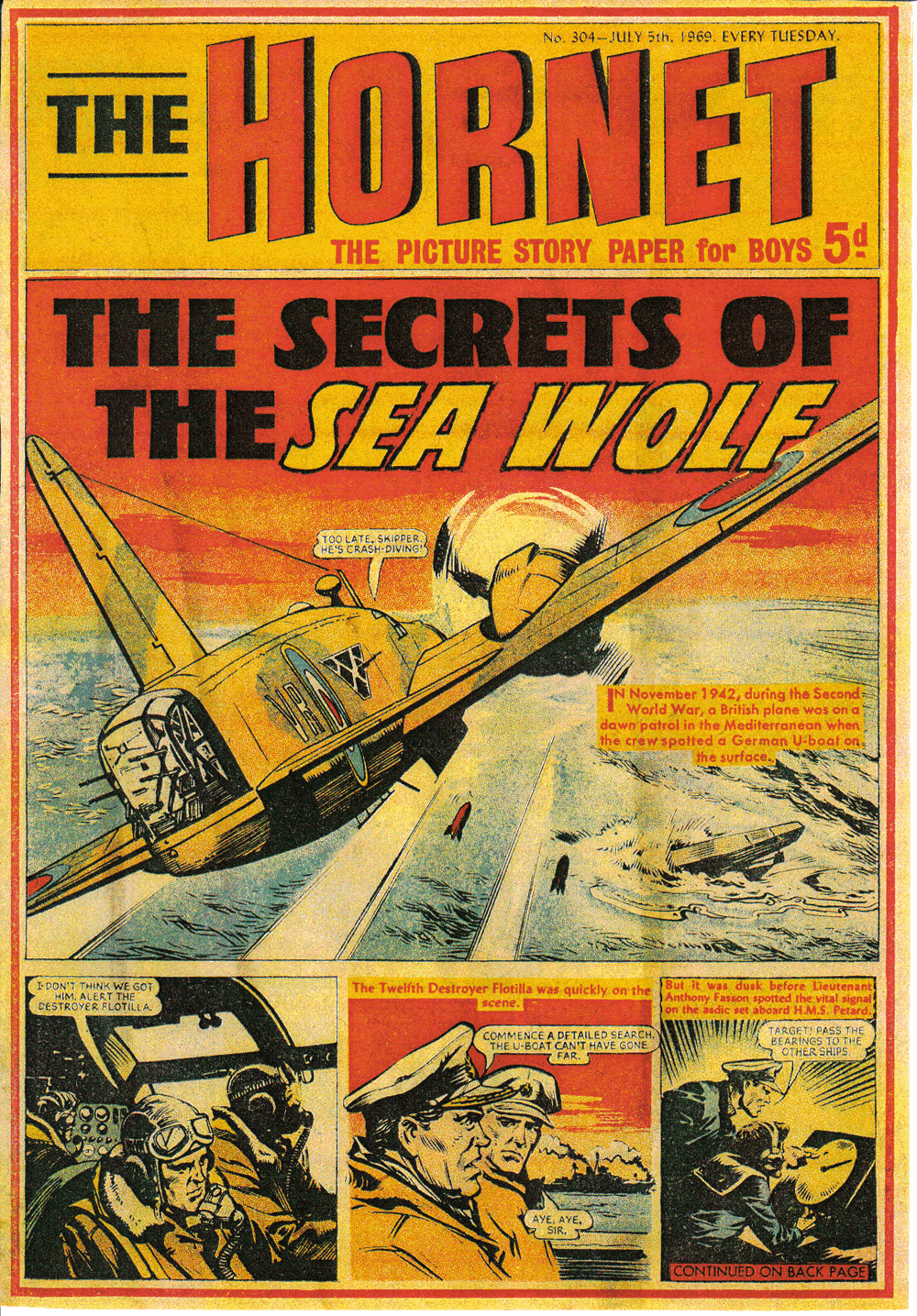
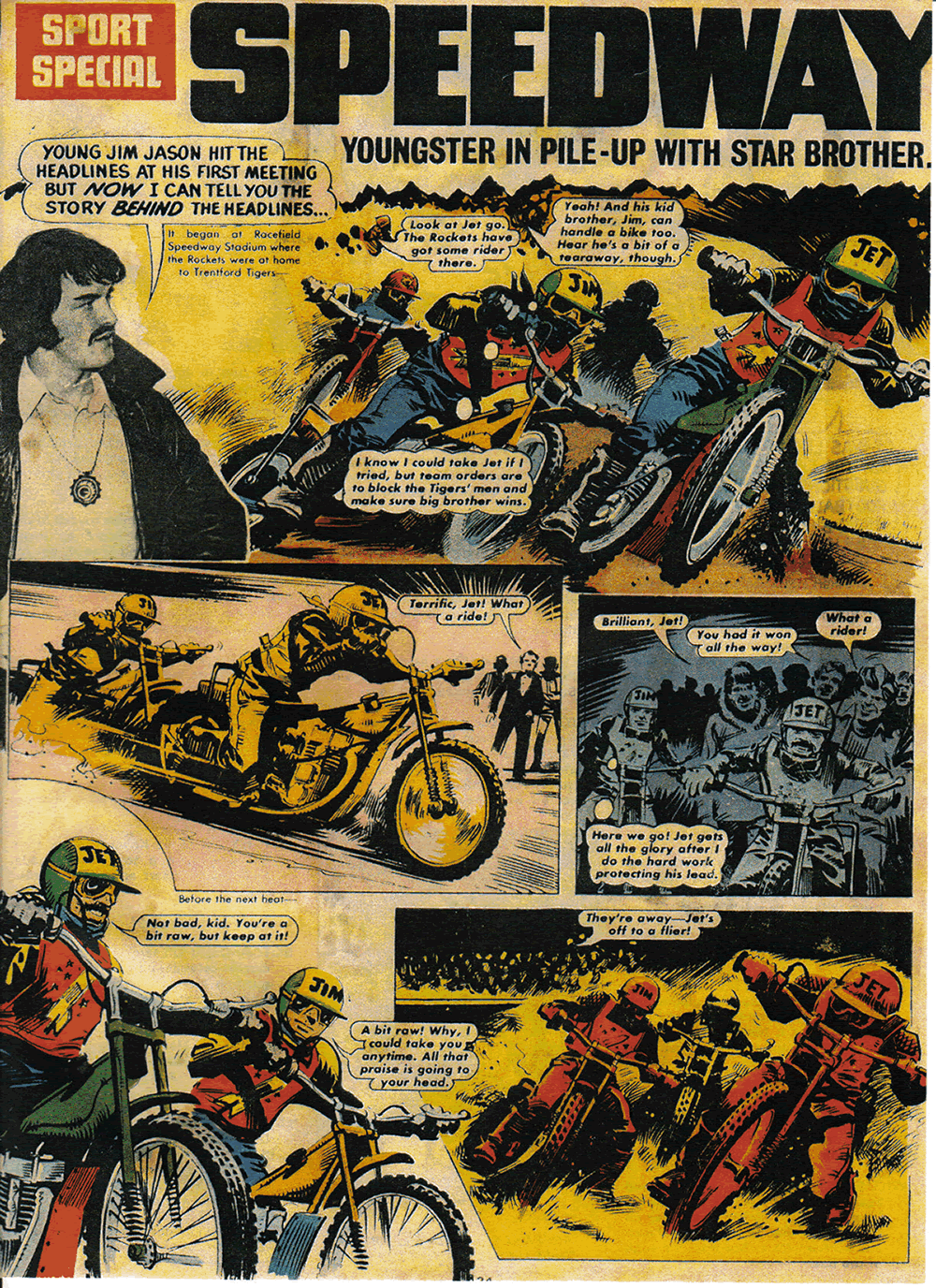
Below are several examples of Keith Shone's artwork from various D.C. Thomson publications.
 |
 |
 |
****************************************************************************************************************************************

Interview conducted during February 2008 via e-mail. JH refers to James Halley.
Q. Can you provide us with a short working biography please?
JH: I worked for D.C. Thomson from 1953 to 1992, when I retired after putting the last issue of The Victor to press. From 1953 to 1960 I was on first The Hotspur, then Adventure, both boys' text-story papers, though The Hotspur converted to picture-stories before I left it in 1959. I was involved with The Victor from the start, becoming Editor in 1964.
Q. Was the 'birth' of The Victor difficult?
JH: The launch of a new boys' paper is never easy, editorially speaking. In the case of The Victor, the most important thing was to get the right mix of stories. Adventure, war and sport were the main themes, and the stories themselves had to be structurally strong, leaving the readers keen for more.
Q. Was it a radical change in publishing a comic with strip stories as opposed to text stories?
JH: Picture-stories are different to text-stories. For example, those which were converted from text tales had to be simplified, keeping only the skeletons of the stories but being careful to retain their essence. There is not so much scope for digression, however interesting, in a picture-story.
Q. As Editor what were your aims in producing the comic? Were there any editorial guidelines that writers and artists had to follow?
JH: The aims of the editorial team were to produce a robust, entertaining read for boys, keeping to the high ground ethically without being preachy.
Q. It’s noticeable in 'The Victor' that some strips finished their run, but still had unpublished episodes that were published later as stand alone episodes, why was this?
JH: Stand-alone episodes of earlier series were were usually the result of programme planning. When a "push" was due, with a free gift, several new stories would be started, which could mean cutting one or two instalments of previous series to fit this requirement. The "chopped" instalments could sometimes be used later.
Q. Did the writers and artists all work for D.C. Thomson, or was freelance staff employed?
JH: The writers were all free-lance. The picture-stories were drawn by a mixture of staff and free-lance artists. Stories involving long-running characters such as Alf Tupper were written by various authors.
Q. Was editing 'The Victor' a pleasant or difficult job?
JH: I enjoyed my job.
Q. What were the duties of the editor in a typical week of editing ‘The Victor’?
JH: Evaluating the scripts of free-lance authors and getting them to alter them where necessary. The same with artists' offerings. And of course putting an edition of "The Victor" to press every week. There were also Annuals and Summer Specials to be fitted in too.
Q. I assume that writers had to submit ideas to the editor and if they were of interest they would be commissioned to write a series?
JH: Most story-lines were thought up by the editorial staff and would be discussed with free-lance authors, who would then have an input.
Q. What made a good strip story?
JH: A good picture-story should start actively, without any tedious run-up. It should be clear and easy to understand.
Q. As editor did you try to ‘push’ for more realistic stories or try new ideas?
JH: Good, strong story-lines were paramount, whether realistic or fanciful.
Q. A lot of the artists were European, why was this, was there a shortage of British artists? I assume that most if not all of the writers were British.
JH The writers were all British.The artists were both British and foreign. We just picked the best ones we could.
Q. My knowledge about the printing process of ‘The Victor’ is a bit hazy. Am I correct in thinking that the artwork was done on A2 sheets of paper? I assume they then had to be reduced to A4 size before printing. How was this done? How were the pages then transferred to the plates?
JH: The artwork was drawn "twice up", i.e. double the size on the printed page, on good quality artists' board. Then it was reduced photographically before undergoing an etching process to produce the plates.
Q. How many copies of The Victor were published weekly on average in its first decade?
JH: A little over 400,000. "The Victor" was the best-selling boys' paper for many years.
Q. I always enjoyed the war and sport stories in the comics, and I have the impression that they were written and drawn by people who had personal experience of being in a war or sport. Did they then use that experience in the strips? Was this the case?
JH: Many of our writers (and artists) had wartime experience, and this was reflected in their work. Some had been keen sportsmen or keen observers of sport. But writers are firstly imaginative beings.
Q. Who did the lettering? Was that the artist’s responsibility or was this added back at D.C. Thomson’s offices?
JH All lettering was done in D.C. Thomson's offices.
Q. Did you script any of the strips? As an editor I assume you must have had some experience of art and writing. Did you have to look at the strip, art and script wise and also from the point of view of the reader?
JH: I, and the other editorial staff, wrote many scripts, mainly by converting existing text stories. We also wrote Annual and Summer Special scripts from scratch.
Q. Did you have any favourite Victor stories?
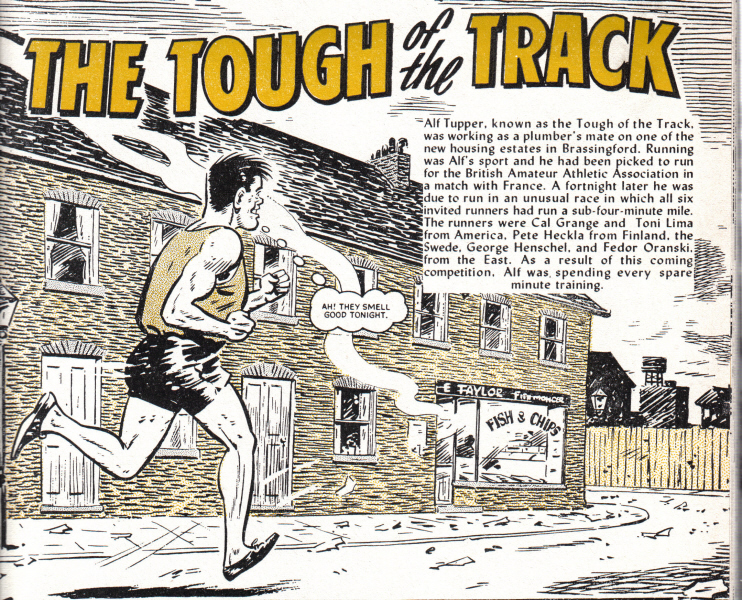
JH: The Tough of the Track was my favourite character, and the readers' favourite too, judging by the polls conducted through our letters page.
Q. I would assume that the centre story strip wasn’t all in colour to keep the costs down. But why was the centre ‘colour’ story coloured red, why not blue or another colour?
JH Red just seemed more effective.
Q. Why did ‘The Victor’ start reprinting and recycle old strips (with new artists) in the 1970’s rather than commission new work?
JH: There was a new generation of readers by the 1970's, so occasional reprints of popular series originally published ten years or so before were appreciated by them.
Q. As a lad I enjoyed reading 'The Victor’ stories set in different parts of the British Empire (as it was then), for example, Australia, Canada, Africa, South America and so on. Was this a deliberate ploy or were the stories reflecting the world at that time?
JH:Apart from stories set historically in the British Empire, there was no deliberate leaning towards such a setting.
Q. Would you agree that ‘The Valiant’ was a different comic to ‘The Victor’ as regards the style and theme of stories they printed? Was there any temptation do try and print similar stories in ‘The Victor’? Fleetway would have been one of D.C. Thomson’s rivals and I assume Thomson’s kept a close eye on what they were doing in their comics.
JH: Of course we did keep an eye on rival publications, but I don't remember any one in particular.
Q. Did any of the D.C. Thomson boys comics suffer any interference from outside bodies, for example, because it was a boys comic showcasing war therefore politically incorrect or because they felt that the comics just weren’t suitable for young lads?
JH: There was no interference from outside bodies, though as time went on the occasional person wondered whether continuing to use war stories was wise. The readers judged these series on their merits as good reads.
My thanks to James and Joyce Halley for their time and patience in answering my questions and to Bill Moodie.
© Adrian Banfield, 2008.
 |