Last updated June 2008. Review of Stone of the Secret Service, with artwork by (possibly) Ted Kearon added. Next month The Dragon Flag, with artwork by Ted Rawlings.

A new page, Victor Hornet comic articles has been added. On this page occasional articles about both comics will be added. The first article looks at advertising within both comics. Please scroll down this page and click on the man writing in a book animation button on the left hand side.

The flags below represent the nationalities of those who worked on The Victor and The Hornet whether they were editorial staff, writers or artists. The comics may have been British as regards the stories that were published and in design and style, but the European artists also gave them a European flavour.

Great Britain's Union Jack England's Saint George flag Scotland's St. Andrews flag The Welsh Dragon of Wales The flag of Spain The flag of Malta, courtesy of www.virtuallandmedia.com

Welcome to my website.

The Victor incorporating THE Hornet

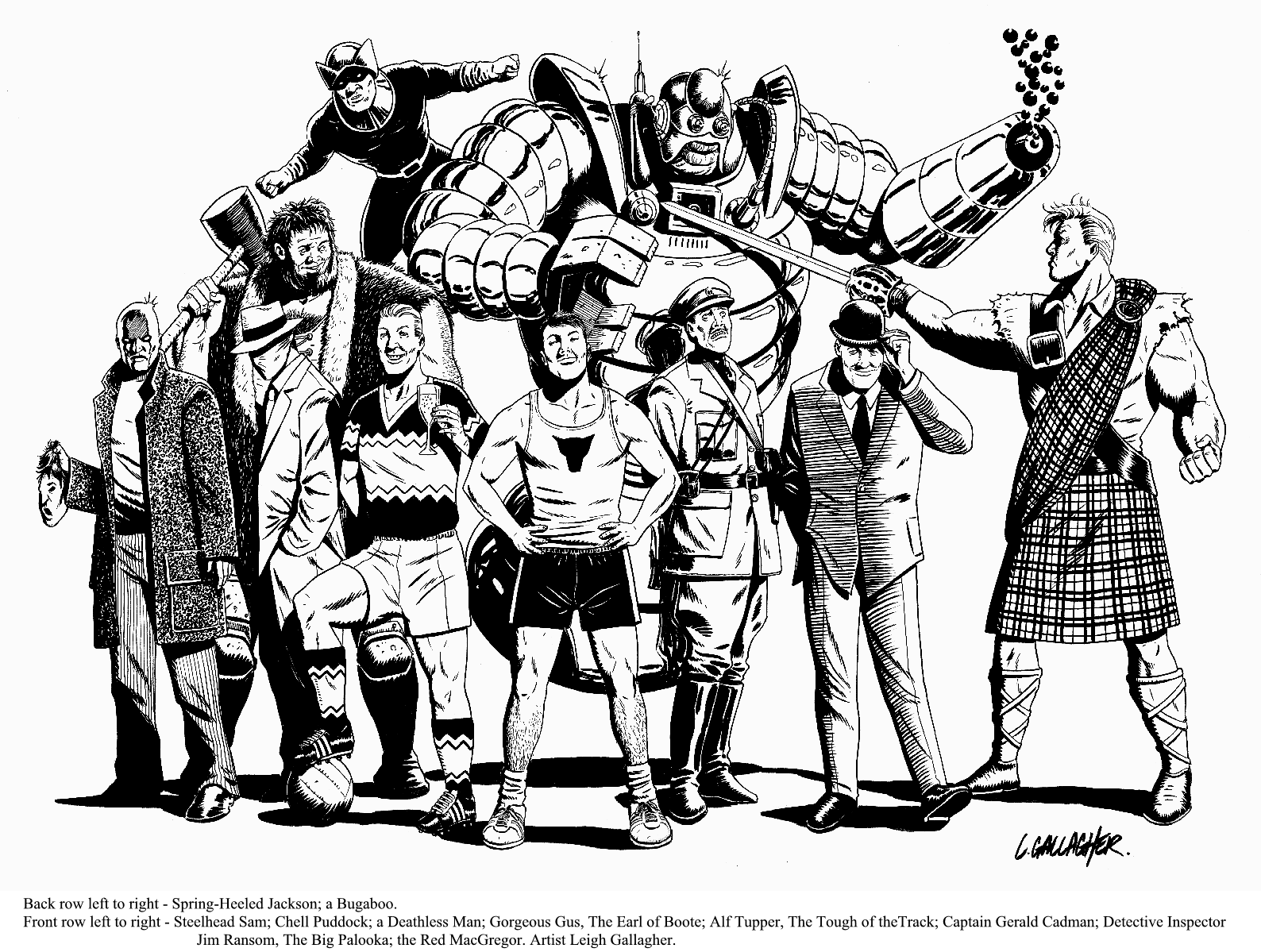
Featuring Captain Neilson : The Man in the Mine, The Bombs with the Purple Stripe, (from The Victor); Inspector Jim Ransom, The Limping Man (from The Hornet) and many, many other wonderful characters and strips!


Victor Hornet comic logos. © D.C. Thomson & Co. Ltd

The Help for Heroes website is a U.K. charity devoted to raising money for wounded British Armed Forces personnel. If you would like to help please visit their website where you can buy a mug or item of clothing or make a dontation. The website also has details of how the money the charity raises is used or will be used in assisting those personnel wounded in action. (I can recommend their very handsome bone china mugs).

Help for Heroes.

Reviews of Victor and Hornet strips, interviews, articles and identify the artist page

Victor Hornet comic articles.
Victor Hornet comic articles

Links and reference page.
Links and reference page

Interviews with editorial 
staff, artists and writers.
Interviews page

Identify the artist
Identify the artist page

The Bombs with the Purple Stripe. A Victor story.

The Man in the Mine. A Victor story.

The Man with the Brazen Mask. A Victor story.

Nightingale Nobbs. A Hornet adventure.

The Hornet's Letter Page

Inspector Jellicoe. A Hornet adventure.

Vengeance of the Snow Wolf. A Hornet adventure.

The Wild Colonial Boy. A Victor story.

Steelhead Sam. A Victor story.

Stone of the Secret Service. A Victor story.

How to prolong the life of your 
comics


This website is an introduction to The Victor and The Hornet comics published in Great Britain for boys (and any girls who were interested) by D.C. Thomson. All images on this site are copyright of D.C. Thomson & Co Ltd. For further information regarding D.C. Thomson's please visit their website at D.C. Thomson & Co. Ltd

As this site grows readers will be able to read a brief history of the both of the comics, working biographies and interviews of some of the artists, writers and editorial staff. In addition I am hoping to provide an index of The Victor comic which will allow users to search for their favourite strips and artists. This will not be a complete index of every Victor comic published. Time, money and resources will not allow for that. (After issue 600 of The Victor, numerous strips were reprinted anyway).

Please note that I have compiled my Victor index as an Excel spreadsheet, (which so I'm told by those who know these things), are difficult to attach to a website! In the meantime, (whilst I try and come up with an alternative solution), if anyone wants to know when a certain strip started or when a particular character appeared in the The Victor or The Hornet please let me know and I will do my best to help. Both indexes only cover up to about issue 600.


For those wishing to learn more about various strips, reviews will be provided. This will serve as an introduction for those who have never encountered the characters before and for those who wish to re-acquaint themselves with the various strips. One complete episode from the pages of The Victor or The Hornet is also provided with each review for your enjoyment.

Conservation of comics is something that affects all comic collectors. A small section devoted to this subject will explain why comics become brittle and tips on how to conserve your precious comics.

Finally, your help is required. Much information about British comics in general has been lost or not saved for future generations. In this part of the website you will find examples of artists work which I have not so far been able to identify. Artists who's work has been identified can also be found here, along with any other information about them. Any information about the writers of the various strips is also required. If anyone can help please contact me via my e-mail address. Please enjoy your time browsing this website.

What is meant by the term comic book?.

The Encyclopedia of Ephemera edited by Maurice Richards says, 'The term 'comic' refers normally to a printed publication in which a narrative is presented as a connected sequence of pictures, usually drawings. In modern times secondary characteristics are the succession of sequences in instalments, featuring the same basic 'cast'. The term is used loosely to refer to the individual strip-series appearing as a regular feature in a publication to the magazine or newspaper supplement devoted largely to such strips and to the comic book.'

Comics and Sequential Art

Will Eisner is regarded as one of the great masters of comic book art and one of the earliest comic book creators. Eisner started working as a cartoonist in the 1930's. His most famous cartoon strip is the The Spirit, which was syndicated in newspapers world-wide for a dozen years. His theories of comics and sequential art were incorporated in his scripting and drawing of The Spirit strip. Many of his ideas were formed whilst working under great pressure in the production of a seven page weekly comic!

Eisner then worked in producing a monthly technical manual using the comics medium for the United States Army for over two decades. In 1978 Eisner wrote and drew the pioneering graphic novel A Contract with God and since then several other graphic novels. Eisner died in 2005.

Will Eisner's Comics and Sequential Art definies the term as, 'When one examines a comic book feature as a whole, the deployment of its unique elements takes on the characteristic of a language. Comics communicate in a 'language' that relies on a visual experience common to both creator and audience. The format of the comic book presents a montage of both word and image, and the reader is thus required to exercise both visual and verbal interpretive skills.

In its most economical state, comics employ a series of repetitive images and recognizable symbols. When these are used again and again to convey similar ideas, they become a language - a literary form, if you will. And it is this disciplined application that creates the 'grammar' of Sequential Art.'

Source - EISNER, Will Comics and Sequential Art.- Florida: America, Poorhouse Press, 1985.- ill b+w.- 158p.- Pbk ISBN 0-9614728-0-2.-

e-mail me Or e-mail limpingman@yahoo.co.uk

A brief history of The Victor - (1961- 1992, published every Monday).

Editor, James Halley, who edited the comic from 1964 to 1992. Read an interview with the editor here.

The Victor, a thirty-two page comic for boys, was published by D.C. Thomson Co. Ltd, who are based in Dundee, Scotland, and who have been publishing comics since the 1930’s and continue to do so today. The Victor though was a comic with new ideas consisting of mainly strip stories and couple of text stories. (Stories tended to be three or four pages in length). In later years only one text story was published and later still, it was all strip action.

The majority of strip stories in The Victor and The Hornet were adapted from the text stories that had been published in earlier D.C. Thomson comics, Adventure, The Wizard, The Skipper, The Hotspur and The Rover. New stories were written either by The Victor editorial staff or by freelance writers.

The emphasis was on the ordinary man or boy involved in action adventures. Stories involved decent, upstanding British or Commonwealth men and boys fighting in wars, or competing on the sporting field or in general adventures, including sci-fiction yarns. (Americans did appear but they were few and far between. And if they did appear, they needed the help of our brave lads to help them out of whatever mess they had got themselves into. This wasn't a snub towards the Americans. Every nation likes to tell stories about it's heroes and characters in a good light. Having said that though Americans did feature in several strips for example, The Guns that won the West, featuring Dusty Fog , Cross Draw McGraw, Cottrell of the Rangers, Duke Farlow : Big game Fisher and other stories in The Victor. And in The Hornet, Laramie a western based on the TV series).

Although not all of the characters who appeared in The Victor were whiter, than white. One of these characters appeared in the strip Crib Carson – fighter. Carson was a boxer aiming for the big time and quite happily cheated every week, by distracting his opponent in the boxing ring. He did this by pretending to be ill or using some other distraction ruse. Carson got his come-uppance in the end and so ended what could have been a brilliant career for the boxer. For Crib was a natural fighter and didn't need to resort to tricks in order to win. The moral of the story being, cheats don't prosper.

Other well known characters such as Alf Tupper, the runner; Sergeant Matt Braddock, World War Two pilot; Morgyn the Mighty, the strong man and Gorgeous Gus, the rich owner/sometime football player, who had all appeared in other D.C. Thomson comics, were dusted off and given a new lease of life in The Victor . These four characters were very much the backbone of the comic and one or all of them appeared almost in every issue for the first twenty, twenty-five years or so.

One other character also appeared regularly in The Victor Private (later Corporal, later still, Sergeant) Millar of the Coldstream Guards, who’s adventures span the entire 1914 to 1918 First World War. Millar fought mainly on the Western Front, but managed to find time to go to Gallipoli with the Worcestershire Regiment. There are parallels with Pat Mills famous Charley’s War series in that both strips cover the entire First World War and do spell out what happened on the Western Front and in Gallipoli. But there all similarities end. Millar remains untouched by the whole experience psychologically and Victor readers never really learned the full horrors of what it was like to fight in the trenches. Charley’s War told the impact of war psychologically on soldiers and the artwork showed in brutal, lurid detail the horrors of war.

Other characters tended to get overlooked by the big four, which is a pity as some of the characters and strips are well worth seeking out, reading and being better known. Examples, include The Bombs with the Purple Stripe, The Seventh Mission, Neilson in the floating mine, Killer Kennedy, Licence to Steal, The War of the Second Guns, Wee Bandy, Behind the Crimson Door, Blighty or Bust, Fred Kay’s Crazy Railroad, Sergeant Samson, Sniper Dennison, Solomon Stark: soldier of fortune, The Coming of the Bugaboo, The Dogs of Dan Hollick, (mainly text stories), The Galloping Gunners and many, many others. All of these characters will be covered in this website in the coming months.

The front and back colour covers of The Victor told of the exploits of British and Commonwealth soldiers and of the medals they won. There was the occasional special one page feature telling the biography of entertainers, sportsmen and adventurers. Each issue would be rounded off with a post bag of readers letters. The editors weren’t interested in publishing letters about what the readers thought about the stories in The Victor, they wanted readers to write in about humorous and scary stories or about interesting facts. Post bag Parade was ignored by me in my youth, but now it makes interesting reading. We'll be dipping into the postbag for some readers letters elsewhere on this website, again in the coming months. (I'm hoping in due course to look at the free gifts presented with both comics later, in more detail). The Victor also published an annual every Christmas and a Victor Summer Special every summer.

The Victor was lucky to employ talented writers and artists, many of whom remain anonymous. Some artists are known for example Peter Sutherland who drew Alf Tupper and Keith Shone the Braddock strips. Both artists worked on other strips, Sutherland on Sergeant Samson and The Big Palooka, and many others. The banner changed after issue 651 and several times after that. Please see the two images below, for examples of The Victor's logo. Images copyright D.C. Thomson Co. Ltd.

Victor front cover with original banner. © D.C. Thompson & Co. Ltd. The changed Victor front cover after issue 651. © D.C. Thompson & Co. Ltd.

Around issue 600 strips that had been printed in earlier Victor’s started to be reprinted. New stories were commissioned and were slightly gritter, but certainly nothing of the calibre that can be read in 2000AD today. The Victor sales started to decline as boys were attracted to other gritter comics, such as The Warlord. Other comics were incorporated into The Victor. The tried and tested format changed in 1991, when The Victor was given a new breath of life, with items about football stars, mountain bikes and videos appearing alongside the regular fare. But time was running out for The Victor and published its last issue in 1992. The comic belonged to a different era and it was time to give way to the new kid on the block 2000AD.

The Hornet 1963 to 1976, thirty-two pages (Published every Tuesday). Editor, Alex McIntosh.

(I have a small confession to make, I never read The Hornet as a boy, in fact I only started reading the comic in 2007, when I picked up an issue out of interest. I'm glad I did.)

The Hornet came from the same stable as The Victor, but never seemed to achieve the success of the latter comic. The two comics were very similar in that they gave the reader stirring sport, war and action adventures. Many of the characters were mirror images of those that starred in The Victor. Bernard Briggs was out of the same mould as Alf Tupper, although Briggs tended to excel in many sports. Then there was William Wilson another all round sportsman who over the years has broken many world records. Not bad for someone who was born in 1795 and retired in the 1970’s.

The Blazing Ace of Space, was The Hornet’s response to Braddock. Richard Starr was a fighter pilot who carried a scrapbook around with him, full of valuable information about flying in general, enemy planes and miscellaneous notes. Starr was a ruthless pilot who’s motto was, 'kill the pilot and that’s one less experienced man available to fly against Britain'. He to like Braddock was occasionally at loggerheads with senior authority figures. The series was popular as readers followed Starr’s adventures from the Battle of France, through the Battle of Britain and beyond.

Another very popular strip was V for Vengeance featuring the Deathless Men. These masked resistance men terrorised the Germans during the Second World War and beyond, as they helped to round up Nazi’s who had escaped the Allies. Each member of the Deathless Men had a codename - Jack followed by a number. Not surprisingly Jack One was their leader who was a British agent Aylmer Gregson, who had taken the place of the Deputy Head of Himmler’s Gestapo, Colonel Von Reich.

Artists (and probably writers), who worked on The Victor also produced work for The Hornet. Peter Sutherland provided the artwork for Nightingale Nobbs (a wonderful name), a wrestler with an ugly face, but a beautiful singing voice and The Big Palooka featuring London policeman (Sergeant, then later), Inspector Jim Ransom. Friend and foe who didn’t know Ransom regarded him as a soft touch which he proved otherwise much to their cost. He was given the nickname in the first series by the American New York Police when Ransom was on an exchange assignment.

Other enjoyable strips included The Hover Rovers, The Blitz Kid, The Limping Man, Shark Squad, Vengeance of the Snow Wolf, (the last two strips drawn by Keith Shone), Deep sea Commandoes, One Man on a Camel, Sergeant Sixty and many, many others. This website will look at all of the above strips and others in the coming months.

The stories on the front and back covers of The Hornet featured the exploits of sporting heroes, ordinary people and military personnel. But as The Victor had cornered the market on the tales of heroes of the First and Second World Wars, The Hornet featured stories of British and Commonwealth military personnel who had fought in conflicts after World War Two. Another difference between the two covers was the constant change in The Hornet’s banner. The Victor kept its first banner for 650 issues, but The Hornet’s banner had changed at least four times by issue 150. Examples of the four different banners are reproduced below.

In later years The Hornet like The Victor had also started to reprint some of its earlier stories. New strips did appear such as the ‘superhero’ (he had no super powers), Captain Hornet taking over the front cover duties. Eventually, though it went the same way as other boys comics and it was cancelled in 1976.

Images copyright D.C. Thomson Co. Ltd.

Hornet front cover with original banner. © D.C. Thompson & Co. Ltd.Second Hornet revised front cover. © D.C. Thompson & Co. Ltd.
Third Hornet revised front cover. © D.C. Thompson & Co. Ltd.Fourth Hornet revised front cover. © D.C. Thompson & Co. Ltd.

Bibliography

The Victor and The Hornet comics.

CLARK, Alan Dictionary of British Comic Artists, Writers and Editors.-

GALLAGHER, Brendan Sporting Supermen : The true stories of our Childhood comic heroes.- (Featuring Alf Tupper, William Wilson, Roy of the Rovers, Gorgeous Gus and others).

GRAVETT, Paul Great British Comics.-

KIBBLE-WHITE, Graham The Ultimate Book of British Comics.-

© Adrian Banfield, 2008.