Many of the artists below have now been identified, but many are still unknown (at least to me). Can anyone identify any of these artists please?
This page has now been arranged into two sections -
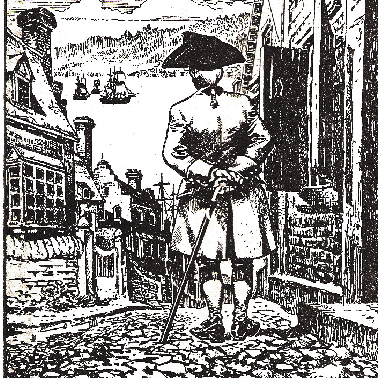
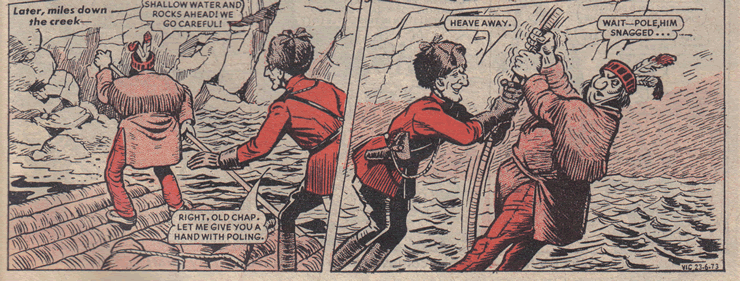
As I re-read The Victor and Hornet comics a pattern is emerging of artists being associated with various strips. For example, Sutherland with Alf Tupper (although in this artist's case he enjoyed drawing the Tough of the Track and had an affection for the character), Keith Shone with the Braddock strips, Fernandez with the William Wilson strips, Ted Rawlings with The Red McGregor, and other 15th to 18th century strips, Bert Vandeput who drew The Greenhorn strip below, drawing many of the football and cricket stories for The Victor. All of the other artists appear to have avoided being 'typecast' and drew war, adventure and sporting strips. Josep Marti being the best example.
My thanks to Colin Noble, Ray Moore, Jeremy Briggs, Steve Holland, Patrick Brown, Jim Croasdale and Antony Harding for providing information about various artists.
If anyone would like to share any information about any of the artists on this page please contact me at
Sources
Unidentified Artists
Marie, Jean?

This is another artist who's identity needs to be confirmed. He drew artwork mainly for The Victor and some of his strips include Wonderman, The Amazing Mister Eel; The Building of the Albermarle; Escape or Die; James B. Quick; The Last Six Hundred; Rudge of the Runners and other strips. It would be fair to say that his art style may not be to everyone's taste.

An unidentified artist. The above piece of artwork is from the humorous, sport story The Floating Footballers, Victor issue 647.

Another unidentified artist. The above piece of artwork is from the schoolboy football complete story, St. Oswald's Star Substitute, Victor issue 646.

Another unidentified artist. The above piece of artwork is from the humorous football series Jimmy's Football Genie, Victor issue 637.

An example of artwork by an artist who I think is well known, but not too me. He or she drew plenty of humorous strips, not just for The Victor, but other D.C. Thomson titles as well.

Another unknown artist's work. I think this artist also drew The Bombs of the Purple Stripe, The Matchbox Marvels, The Saving of the Citadel and Licence to Steal!

Is the above artwork, from the football strip, The Ninety-Minute Nelsons by a Spanish artist called Garcia? (From Hornet 424). This strip and much of his other comic artwork appeared in The Hornet. He also drew many episodes of Captain Hornet.
This artist drew several strips mainly humorous for the Hornet comic. He or she has a unique style, with the ability to convey humorous situations in a rib-tickling way. Picture from Hornet issue 424.
A to Z of Artists by Surname
Alcatena, Enrique
 |
 |
The very finely detailed artwork above is by an artist whose work appeared in the Victor during the late 1980's early 1990's. Alcatena puts so much effort and fine detail into every panel that it makes his artwork a joy to view. I find my eyes roaming over the artwork long after I have finished reading that panel's captions.
Alonso, Matias

The above artwork is by Matias Alonso, a Spanish artist. The artwork is from a Shiwa Sands story. The artist also drew Johnny Ghurkha, The Coming of the Bugaboo, Task Force with Tusks, Joe Coleman’s Guerrilla’s, The Wild Colonial Boy, to name a few. All of these strips appeared in The Victor.
Arnau?

The above artwork has been identified as Arnau, this by the famous western writer J.T. Edson (who wrote stories about the western character Dusty Fog and other characters), who wrote many scripts for The Victor as well as other D.C. Thomson comics. But can anyone provide me with any other information about this artist?
Bagnall, C.D.
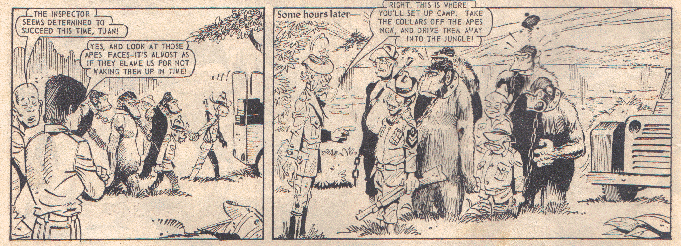
The above artist, C.D. Bagnall, mainly drew humour strips for The Victor. Strips include Charlie the Tester, Cecil - the stone age scrapper Lord of the Yukon, Stokehold Joe, Feuding Finnegan, Slaves of the Evil Eyes, Danny Dixon's Crazy Railway and Keeper of the Apes.
Bevan, Jeff
Bleach, Jim


The two pieces of artwork above are I believe the work of Jim Bleach. The artist had a difficult act to follow in drawing the Tupper series. (For me, Peter Sutherland rules supreme), but Bleach's work for Gladiators of the Desert and other Victor strips is excellent.
Carrion, Felix (Spanish)
The artwork below is by Felix Carrion. Artwork from They Joined the Legion. This dramatic strip told the stories of individual soldiers lives.

Coleman, Anthony (Tony)

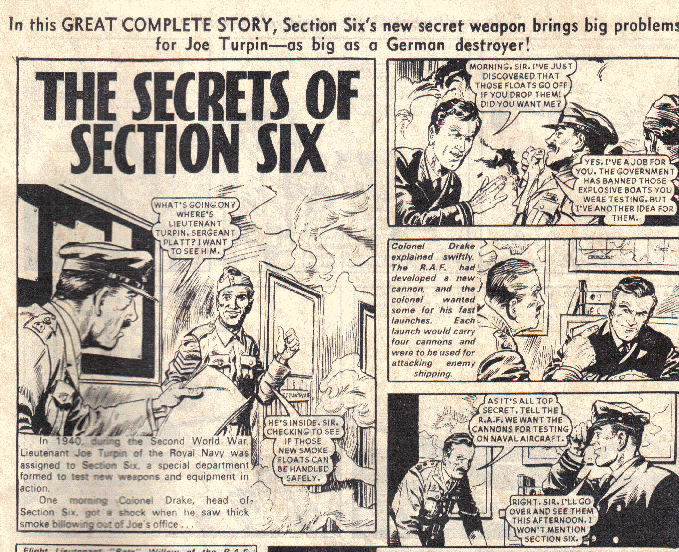
The above two pieces of artwork are by artist Anthony Coleman. The first strip is from the Battle comic dated 03/11/84. The second image The Secrets of Section Six is from The Victor. Other Victor strips this artist drew include The Moaning Minnie, The Men Behind the Barbed Wire, The Barge that went to War, The Wavy Navy, The Monster of Loch Neill, The Battleberg and many others.
I also believe that Coleman worked for a short period in America, working at the Wood Studio with Wally Wood, the well known comic artist. Coleman's biography in the collected T.H.U.N.D.E.R. Agents volumes mentions that the tall artist was born in 1932 and travelled to Canada, 'but lost his portfolio and money whilte en route to DC Comics in New York. On the basis of his work for British digest war comics, DC's Joe Orlando sent him uptown to the Wood Studio.' (T.H.U.N.D.E.R. Agents, volume one, DC Comics, 2002). He worked with Wood on T.H.U.N.D.E.R. Agents from issues 2 to 5. He inked Gold Key's, Fantastic Voyage, drew illustrations for Galaxy Science Fiction and on Warfront for Harvey Comics. After six months though Coleman returned to England. Unfortunately, it is not possible from the artwork T.H.U.N.D.E.R. Agents to easily identify his work. Possibly Coleman only inked Wood's artwork. Is this the one and same person?
Diaz?

Artwork from a Victor Annual story, Neilson in the Floating Mine, featuring Capt. Tom Neilson and his mine in a dramatic situation. Believed to be the work of a Spanish artist Diaz, although more information is required about this artist. (Thanks to Ray Moore for supplying the information). Also drew the second series of Sniper Dennison, Suddenly, The Raiders Were There!, The War of the Second Best Guns and The Sands of Sudden Death.
Dorey, Mike
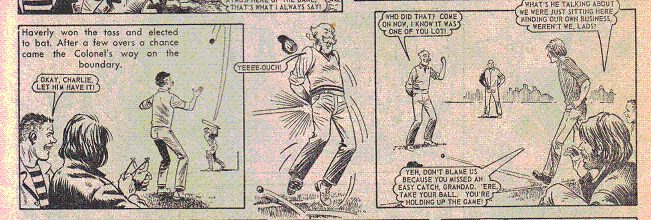
The above artwork from Is it Cricket? The artist also drew the second series Howzatt?? and many of the Cadman strips, several Morgyn The Mighty strips and one of the last Alf Tupper series. He also drew artwork for the Warlord, Tornado and 2000AD comics.
Farrugia, Harry

Artwork from 'The Man with a Donkey’ (Victor Summer Special 1970).
The above artwork is the work of Harry Farrugia. For further information about this artist please follow this link
Some examples of strips that Farrugia drew for the Victor include - The Man with the Brazen Mask, The Men from Camp Z, The Last Boy in Singapore, "Killer" Kennedy, and one series of the World War One series featuring Bob Millar as well as many other strips. And for The Hornet he drew The Limping Man, Sergeant Sixty, The Hover Rovers, One Man on a Camel and many other strips.
Fernandez, Edmundo (also known as Ripol).

As far as The Hornet is concerned Edmundo Fernandez is associated with the William Wilson strips, of which there are several. He also drew other strips for The Hornet. This artist was known to Bill Graham (a Hornet sub editor) as Ripol.
Giralt, Joan

Bill Graham, who worked as a sub editor on The Hornet has identified this artist as Joan Giralt, a Spanish artist who specialised in football stories. The Blitz Kid tells of the adventures of Arnold Tabbs as a young boy during the Second World War. The Tabbs character as an adult would go to appear in other football stories in The Hornet usually as an assistant to Nick Smith, another famous Hornet footballing character.
Godwin, Frank

The above image is from The Hotspur issue 21.
Godwin (20th Oct. 1889 to 05th August, 1959), was an American illustrator and comic strip artist, notable for his strip Connie and his book illustrations for Treasure Island, Kidnapped, Robinson Crusoe, Robin Hood and King Arthur. He also was a prolific editorial and advertising illustrator.
Rusty Riley was an American comic strip which ran from 1948 to 1959. It was created and drawn by Frank Godwin for King Features in the US. The storyline follows the adventures of a redheaded orphan youth, Rusty Riley, who flees the orphanage with his faithful fox terrier, Flip. In the Bluegrass region of Kentucky, he is hired as a stable boy by wealthy racehorse owner Mr. Miles, owner of Milestone Farm. Encountering crooks and corruption as he grows up in the world of horse racing and horse breeders, Rusty's goal is to establish himself as a jockey. Rusty's girlfriend is Patty Miles, the daughter of his boss.
Godwin made research trips to Lexington, Kentucky, when he began drawing the strip, but complaints about the appearance of horses and farms led to a return visit, as described by comics historian Dave Karlen:
Instead of ignoring these complaints, as some cartoonists might have done, Godwin made another trip to Lexington to visit his critics. For more than a week, he toured the central Kentucky horse farms, took pictures and made numerous sketches of the horses, fences, gates, barns, farm homes, horse cemeteries, country lanes, trees, and other references necessary to make his strip correct. He talked with the thoroughbred horsemen, standard-bred horsemen, saddle horsemen, racetrack officials and newspapermen to get all the information he needed. He also took many pictures in and around the Keeneland and Lexington Trotting Tracks, which were a couple of the sites he later used frequently in his comic strip. Godwin was now ready to make his strip better than ever.
For those who are interested the Rusty Riley strips are being re-printed in hardback by Classic Comics Press as of 2013. The above information is from Wikipedia.
Stories from the Rusty Riley series were published in The Hotspur. It was very rare for D.C. Thomson to re-print complete stories from other countries. It would be interesting to know how this series came to be printed in The Hotspur, why this one and why was the experiment not continued?
Harding, Tony

The above artwork is the work of Tony Harding. The above view is the first historic meeting between The Victor's Alf Tupper and The Hornet's Bernard Briggs. They met for the first time in the Hornet comic. For further information about this artist please follow this link
Holroyd, Albert (brother to Bill Holroyd).

Albert Holroyd drew the final four issues of the Fred Kay's Crazy Railroad series. Fred Kay's Crazy Railroad, for The Victor. He also drew Slim Jim, the Fighting Cook; Star Spankled Banger; Just add Water and various Victor front covers.
Holroyd, Bill (brother to Albert Holroyd).

Horak, Yaroslav

The above artwork is by Yaroslav Horak, from issue 99 of The Hornet. The artist is famous for drawing the daily James Bond newspaper strips for various British newspapers. He drew his first Bond strip in 1966. Horak lived in Australia for several years, drawing a popular comic series The Mask. He next drew his daily adventure strip Mike Steele. In the early sixties he left Australia to live in Great Britain. He possibly also drew The One Pip Wonder and several complete one issue stories for The Hornet and Johnny Hop (The Victor), and The Bent Copper for The Hornet. The Johnny Hop series is about a policeman operating in the Australian Outback. For further information about the artist please visit Lambiek.net.
Kearon, Ted

The above is probably artwork by the artist Ted Kearon. My thanks to Colin Noble for the information. Colin warns however, that Kearon's artwork was ghosted. And the above example might be in case in point. Kearon drew the Robot Archie strip for The Lion. See also Lambiek.net.
Steve Holland also has some interesting information about the artist, 'I'm reminded of a story I heard about Ted Kearon, the artist of Robot Archie, who lived down on the south coast. Anyone visiting Ted to collect artwork was kept waiting on the doorstep by Mrs. Kearon who was keen never to have her husband distracted from his work. If they needed to talk to him, they weren't invited in; instead, Kearon -- wearing a smock to keep his clothes clean -- was allowed onto the doorstep to quickly deal with any business.' Bear Alley
This artist possibly drew Stone of the Secret Service, (confirmation required). Kearon did though draw several Morgyn the Mighty strips for The Victor. (Information via Colin Noble).
Kennedy, Ian

The above artwork by Ian Kennedy the Scottish artist, needs no introduction for those readers who are avid fans of The Victor or D.C. Thomson's Commando booklets. For those who aren't familiar with his work, Kennedy is regarded as one of the finest of British comic artists. His drawings of aircraft and vehicles are accurately drawn, right down to the smallest detail. And his colourful Victor annual and Commando cover artwork is stunning! For Other examples of Kennedy's artwork please visit the following pages - Victor Annual and Victor Summer Special pages.
Please follow the link for two interviews with Ian Kennedy.
McLoughlin, Denis

Denis McLoughlin (artwork above), is another well known and respected British artist. He's probably best known in the UK for his work on the Commando books. (He provided the artwork for over 150 issues. His first issue was no.1623, published in 1982). As far as I am aware the only strip he drew for The Victor was Steelhead Sam, but he provided the artwork for a dozen or so longer strips for D.C. Thomson's The Wizard in the mid to late seventies. (Wizard stories include Power - the Danger Ranger, It's only Zeke, Wolf Boy, Terror of the Tall Tower, The Secret of Black Island and The Frozen Man featuring Jake Jeffords - secret agent, to name a few. Note the last three strips were collected and published by D.C. Thomson under the Red Dagger banner). Early in his career McLoughlin had provided artwork for dustcovers and paperbacks of Boardman Books, (1950's/1960's). These books are highly valued today by book collectors. Other work included the Swift Morgan Science Fiction series, the gang-buster Roy Carson and the Buffalo Bill annual.
'McLoughlin ranks as probably the most seriously studied of British comics' artists, with four books and numerous articles having been written about his comic and book cover art; [his] career spans over fifty years, his earliest comic work appearing in the one-shot Lighting Comics from Kangeroo Books in 1946'.
HOLLAND, Steve d. mcloughlin In Achtung! Commando.- No.2 Winter/Spring 2000.- Privately published by Peter Richardson.-
Marti, Josep
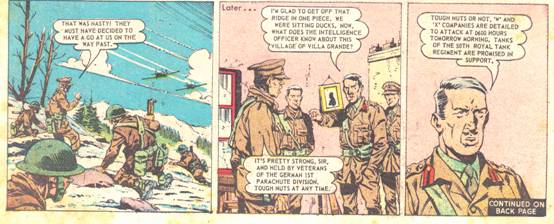
This artwork I have recently discovered was drawn by a Spanish artist Josep Marti. Was his artwork influenced by the American lifestyle? This theory is based on the style of clothes drawn for civilians and the U.S. style cars that appeared in his strips. Artwork from The Victor front cover issue 611. He also drew Bill and Ben, the fighting Tennis Men, The Whirler, Duke Farlow, Crazy Fred Kay's Railroad, The Seventh Mission, and many other wonderful strips. Like many of the regular Victor artists Marti also drew a few Alf Tupper strips.
Philpott, Frederick Alan

I believe the above artist is Frederick Alan Philpott. If so Philpott is probably best known for his artwork on the V for Vengeance strips in The Hornet. He also drew strips for The Victor.
Rawlings, Leo

Artwork from The Sabre-toothed Slinker (The Victor). The artist (please click on the following link for further information about the artist), Leo Rawlings (no relation to Ted Rawlings), also drew The Bubble, Island of No Return and many strips featuring Sergeant Bob Millar set during World War One.
Rawlings, Ted

The above artwork as that of Ted Rawlings. D.C. Thomson's also kept this artist very busy drawing front/back covers and strips for the Victor. Examples of series he drew include The Red MacGregor, Hounds of the Cheviot Mists, The Front-Line Bus, The Hammer Man, The Hot-Air Hussars, Stark of the Samurai, a couple of Alf Tupper strips and many other stories. Rawlings also provided artwork for the D.C. Thomson text comics for example, Rover and Wizard. The above artwork is from The Victor cover issue 619.
Redondo, Jesus
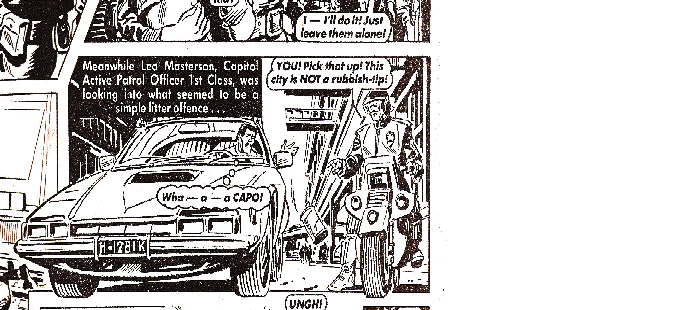
The above artwork from The Marshall of Magnon series is by Jesus Redondo, a Spanish artist. (Image from The Victor, issue 1507, January 06th 1990). Born in 1934 in Spain, his work has been published not only in the UK, but also in Spain, (example titles inlcude Centauro and SOS Dossier Ecologico) Holland (for example, Edward a favourite strip of Redondo's), Sweden and America. In the UK, his work has appeared in 2000AD, (M.A.C.H. 1 and Tharg's Future Shocks series); Eagle (drawing some Dan Dare strips) Starlord, Tornado and other comics. He has also drawn strips for Marvel Comics Star Trek Voyager and Kitty Pryde, Agent of S.H.I.E.L.D..
Redondo, began his drawing career with a Spanish publishing house Bruguera in the early 1960's. He first started to draw strips for D.C. Thomson's and IPC comics in the mid-1960's. Examples of strips he drew include Suzette of the Silver Sword (a non Victor and Hornet story) and other romance, police, fantasy and war adventures. He recently returned to the pages of 2000AD illustrating a Terror Tale short story 'Birth of Mazzikim', which appeared in 2000 AD prog 1737.
Please follow the link to read a short interview with Redondo on the Down the Tubes website.
Richardson, John

I believe this is artwork by John Richardson who these days runs his own comic art business, The Richardson Studio. Artwork from Marmadukes Commandos, which is a humorous World War Two strip, published in The Hornet.
Ritchie, Willie
The following information about Willie Ritchie is from the University of Dundee website -
Born in Glasgow in 1931, Ritchie studied at Glasgow School of Art. After serving in the Korean War during his National Service, Ritchie joined the staff of DC Thomson. Initially working mainly for the Weekly News, he began creating comic strips for the Beano in 1955, and would go on to work for many other titles including the Beezer, Bunty, Sparky, Bimbo and Twinkle. His clean, simple style never dated, and long after his official retirement he was still in demand for the Snooty & Scamp pony strips or the Clan McWee children's books. [Ritchie died in 2010].

Artwork from The Hotspur (second series) Picture comic, issue 37.
Sanchis, Vicente Ibáñez

Artwork from The Victor Summer Special 1970. Is the above artwork by Vicente Ibáñez Sanchis? Also the artist for The Galloping Gunners featuring Tom Holliday and The Queen's Cowboys (The North West Mounted Police). Sanchis also provided artwork for many other strips. Please see the various comic indexes.
Shone, Keith

The above artwork is by Keith Shone, the artist who drew many of the Braddock strips for 'The Victor'. Somehow Keith found the time to illustrate many other strips, such as Shark Squad, Bring-'em-Back Boys, to name a few. Please follow the link for my interview with Keith Shone.
Sturrock, Freddie
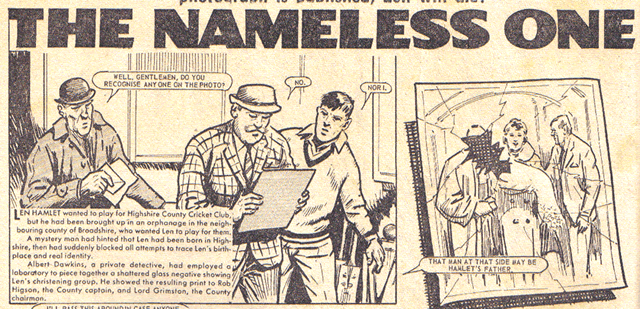
The artist joined D.C. Thomson's Art Department in 1920. He became well known initially as a sports illustrator. In addition to the many picture series he provided artwork for, he also drew many text story header pictures not just for The Victor and The Hornet, but also for other D.C. Thomson publications such as the The Dandy.
'Fred especially enjoyed drawing all-action pictures, much loved and admired by his colleagues. His great sense of humour and infamous green eye-shade made him a target for the in-house cartoons that would circulate round the art department.' The artist drew many cricket and other strips for The Hornet. Source - Riches, Christopher ed. The Art and History of the Dandy.- Glasgow: Waverley Books, 2012.-
Vandeput, Albert (Bert)
Bert (Albert) Vandeput was born in London, England in 1915 of Dutch extraction. Prior to drawing for comics, Vandeput was an art teacher in a Catholic school in Liverpool. He began drawing comic stories for the Roy of the Rovers strip in the late 1950's. By the early 1960's he was drawing mainly sport strips for D.C. Thomson. Bert died in 1973. My thanks to Kashgar for the above biographical information.

Artwork by Bert Vandeput from a Victor story. Vandeput also drew most of the Victor football and cricket strips for example, Behind The Crimson Door, The Team that Jack Built, Mister Roly Poly and other strips.
Gorgeous Gus, Johnny Gets the Runs and so on. The last strip title refers to an Australian batsman scoring runs and not, sadly, an Australian cricketer suffering from another set of runs!Winslade, Harry

The above artwork is by Harry Winslade (1901 - 1980) and is from The Diggers Were There series published in The Hornet, issue 192. The following edited information is from an article that appeared on Steve Holland's website blog Bear Alley. My thanks to Steve. Harry Winslade was born as Harry Redvers A. Winslade, in Farnham, Surrey. (Winslade has also been known as Redvers Blake). Winslade's career in the comics industry appeared to have begun in 1950, drawing episodes for Eagle. Between 1951 and 1952 he drew the Judy and Pat strip for Girl. In early 1958 he drew for the Zip comic The Brainy B's strip and for the Express Weekly Battle Brothers. Between 1958 and 1962 he illustrated the adventures of the explorer Sir Nigel Tawny which started life in Zip and later continued in Swift. But it was within the pages of The Hornet, that Winslade contributed many pieces of artwork drawing front and back cover stories, complete one issue and series stories. He also drew for the Diana and Wizard comics.
Thanks to Steve's Holland's website for the information. Bear Alley. See also Lambiek.net. A useful site providing a listing of artists with brief biographical information and examples of their comic work. Lambiek.net is also a famous comic shop in Amsterdam, Holland.
© Adrian Banfield, 2017.