
Sixteen years on the www - January 2008 to January 2024
Are you reading the adventures of The Guard? Everyone else is!
Want to read a slightly different type of comic which uses Lego mini-figures and buildings, cars and so on to create exciting and visual entertaining stories? Well, why not try out my own humble crime fighting comic - The Guard.
This month's Guard adventure is Story no. 126 Runner Guard and colleagues have arrived in Yorkton.
Please click on the the Guard banner below, to be taken to this month's Guard story.

**** **** **** **** **** **** **** **** **** **** **** **** **** ****
A good starting point for new (or indeed frequent) visitors would be to visit the following page Victor 50th anniversary page. This page provides a timeline of the Victor comic as well as links to other pages on this site, including the Victor and Hornet indexes and series review pages.
Also on this site readers can read interviews with some of the creators who worked on the comics, including the Victor editor, James Halley and Keith Shone, artist; reviews of comic strips, including several episodes of the reviewed strip (one hundred and thirty-six reviews available to read as of December 2015); Victor, Hornet and Hotspur indexes which are updated regularly; a page about the artists (thirty-seven listed as of December 2014); articles about both comics and much, much more. This site is updated monthly. If you wish to contact me please use the link further down this page. Please note all images on this site unless otherwise stated are copyright of D.C. Thomson & Co. Ltd .
 Please click on the images below to be taken to this month's update page.

|


|
During 2013 I commissioned Keith Page to draw the above British comic Thomson character The Black Rider for this website. Page has worked in the British comics industry for many years. Those of you who read the Commando booklets will know the name and his work. Page has also worked on other projects such as the Iron Moon and a Bryant and May story. Both are graphic novels. His blog can be read by clicking on the following link - Keith Page. My thanks to Keith for the drawing.
To go to the previous months updates, please scroll on down the page.
Wizard Picture Story series.


|
Previous series stories can be located via the Victor, Hornet and Hotspur review pages, accessible via the relevant page buttons below as well as links to other pages on this website.

The Victor Index. 
Victor story reviews. 
Hotspur story reviews. 
The Hotspur Index. 
Victor timeline. |

The Victor annual page. 
The Victor Summer Special page. 
Red Dagger review pages. 
Hornet story reviews. 
Hornet Index. |
Below are links to other pages of interest on this website.
And click on the image below to be taken to this month's special feature. In early 2012 I commissioned Leigh Gallagher comic book artist (Defoe, Aquila and Judge Dredd for the British comic 2000AD) to draw for me a Victor Hornet Comics fifth anniversary drawing. Needless to say he came up trumps! Trying to choose ten characters for Leigh to draw wasn't easy. I wanted characters that were there in the early days of the Victor, as well as newer characters in the latter half of the comic's life. Then the characters chosen needed to represent every major genre and also some characters from the Hornet comic. A tall order! In the event I only left the western genre out. But I'm very happy with the result. Thank you Leigh.
For further information about Leigh Gallagher and his work please click on the link. His blog is updated regularly, with news of what he's working on and he also has pages of his artwork for sale.
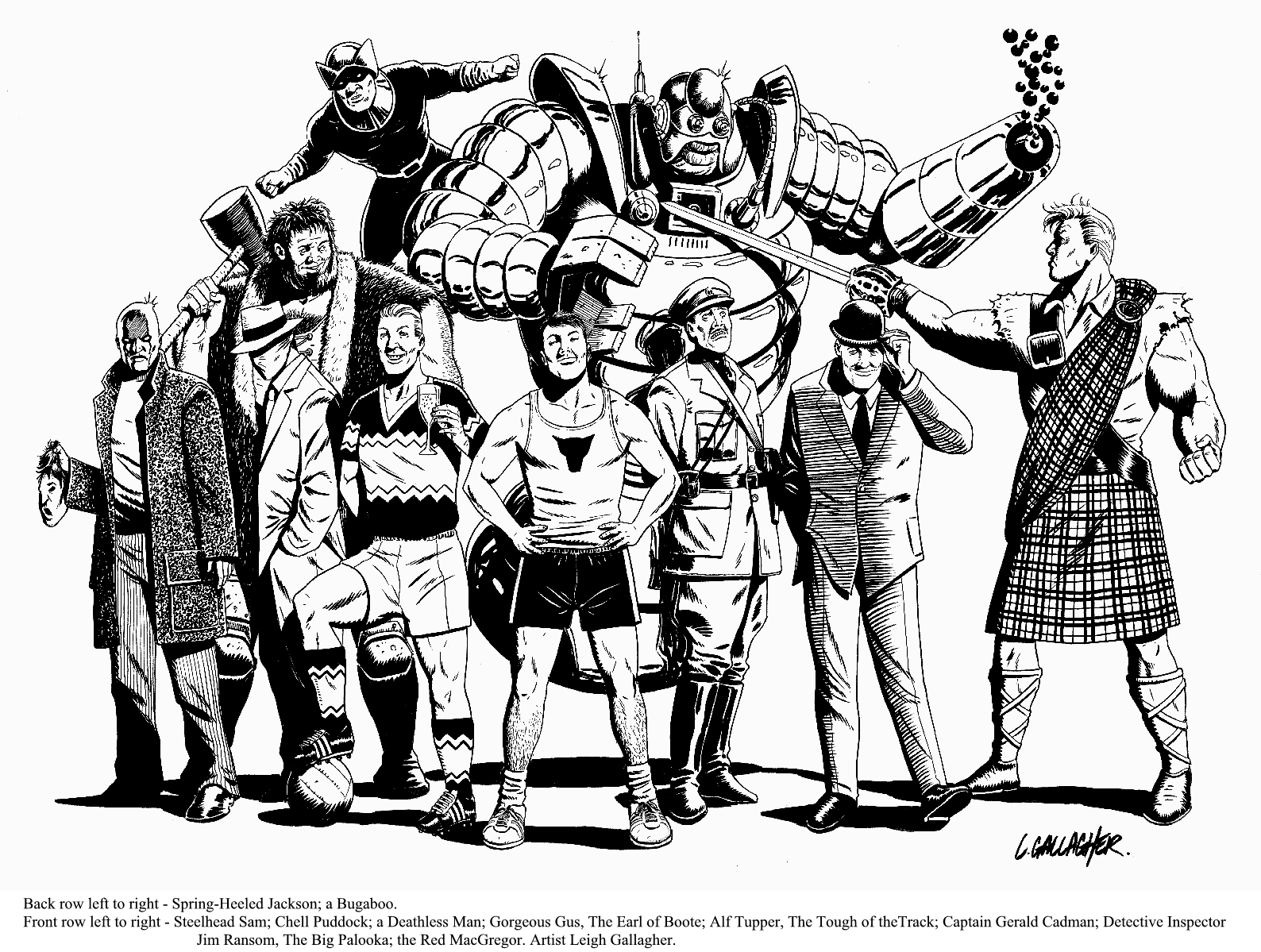
Further information about the characters in the picture above can be found via the Victor and Hornet series review buttons below.
Editorial Ramblings - April 2023.
I've had sometime available for the last four months to update the Victor Index. Once that is completed, I'll move onto finishing the Hornet Index.
This site may well be a one man band, but without the generous help of a lot of people this site would be that much poorer. My thanks (in no particular order) to -
D.C. Thomson for allowing me to use images from The Victor, The Hornet and Hotspur comics, York College for their 'Build a website course', Dan Courtis for helping out with technical details, Vic Whittle, James and Joyce Halley, Keith Shone, Roddie Watt, Calum Laird, Bill Graham, Anna Pichora of the Library and Archives Canada, Alex Vella, Jamie Stripe, Lyn Flanders, Ron Smith, Arthur Tabone, Bill Moodie, Jeremy Briggs, Steve Holland, Colin Noble, Ray Moore, Jim Croasdale, Derek Marsden, Chris Barnett, Andy Longley, Chris Fitzsimons, Paul Sutherland, Susan O'Connor, Leigh Gallagher, Craig Farrugia, and Antony Harding. If I have missed anyone out, my apologies.
Sadly, no new Victor annual since 2017. But you may still find the three Victor reprint annuals available to buy. See details below.
From the Amazon.co.uk website, "The Tough of the Track was The Victor's most popular hero, having instilled the competitive spirit into millions of British lads for over 50 years. A welder who worked under railway arches, Alf Tupper survived on a diet of fish and chips. He was always the underdog, running against posh toffs who devised underhand ways of keeping him off the winner's rostrum. Although Alf often looked beaten, he nearly always came through in the final few strides, exclaiming "I've run him!" as he breasted the winning tape in a photo-finish. Published in the year the Olympic Games returns to Britain, this nostalgic anthology will not only be the perfect gift for the millions of men whose love of sport was kindled in their youth by Alf Tupper, but will also enthrall and inspire a new generation of boys to go and win against all the odds."
The Tupper stories featured are those from the early Victor annuals.
Blooming ada, only £12.99, what a bargin! Order your copy today.
 |
Commando war booklets
Do you enjoy a good war story in pictures? Then why not try a Commando war booklet? Now in its 54th year, Commando is a 64 page, black and white picture comic, slightly smaller than A5 in size. Eight issues are published each month (of which four issues are reprints). Four issues are on sale every fortnight and can be found at all major W.H. Smith stores. (But not at all Smith railway station stores for some reason). Each issue tells a war story usually from the First or Second World Wars, although adventures from other centuries and wars are also told. Below are two cracking Commando booklet covers. Cover artwork on the left by Ian Kennedy and on the right by Keith Page. Please click on the below image to be taken to the Commando website.

The flags below represent the nationalities of those who worked on The Victor and The Hornet whether they were editorial staff, writers or artists. The comics may have been British as regards the stories that were published and in design and style, but the European and South American artists also gave them an international flavour.
 |


|


